



Autobiography: Circles
Howardena Pindell
621 x 294 inches
GPS: 30.281929, -97.738606
For more than five decades, Howardena Pindell’s approach to abstraction has been shaped by her memories and observations of the world around her. Born in Philadelphia in 1943, she studied painting at Boston University and Yale University, worked at the Museum of Modern Art, and later taught for decades at Stony Brook University. She is also a founding member of A.I.R. Gallery, the first all-female cooperative gallery in the United States. Across painting, video, and mixed media, Pindell returns to a familiar set of visual motifs—dots, arrows, and numbers—using repetition and accumulation to build richly layered surfaces.
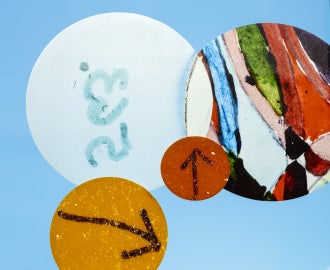
Pindell’s use of dots traces back to a childhood memory of red circles marking dishes designated for Black customers during segregation. Over time, she transformed this memory into a distinctive visual language, creating dense fields of hand-punched paper circles that suggest constellations. Numbers and arrows extend this vocabulary, reflecting the artist’s interest in mathematics and systems, while also pointing to broader ideas of movement, transformation, and social justice. Through her work, Pindell tells complex personal stories that reflect her lived experience.
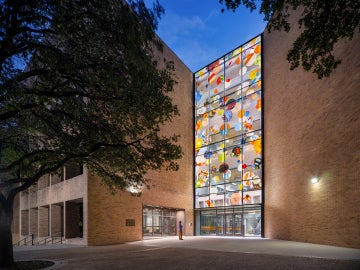
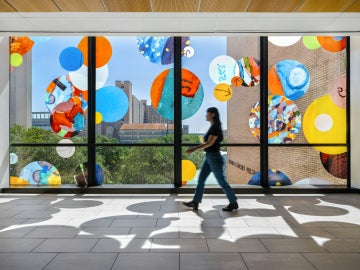
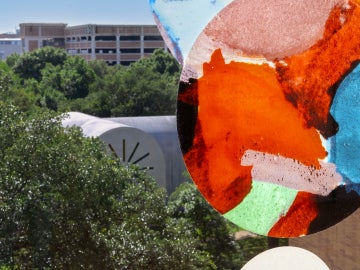
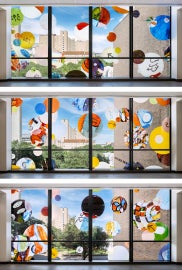
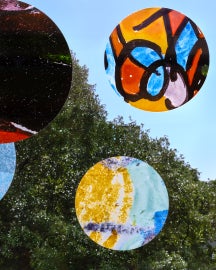
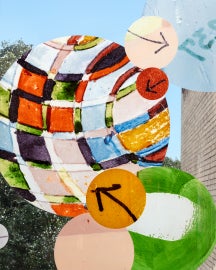
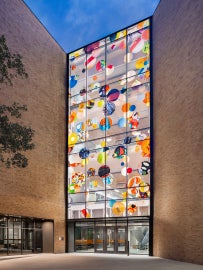
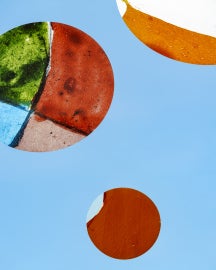
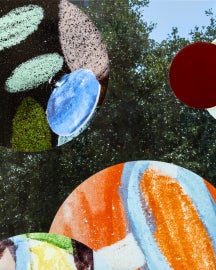
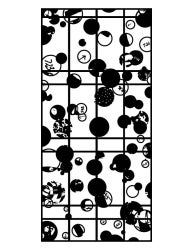
Autobiography: Circles (2026) brings these motifs into a new, monumental form. Installed on the glass façade of the George I. Sánchez Building for the College of Education, the work transforms the building’s entrance into a luminous composition of color and pattern. Created through a digital printing process in which ceramic ink is fused to glass, the surface glows as light shifts throughout the day. The composition draws together visual elements from across Pindell’s career. Some colored circles are scanned directly from earlier works and combined into a new arrangement. Numbers and arrows are layered among them, suggesting systems of measurement and transformation. Together these elements create a sense of movement and depth as viewers pass through the building.
As her first exterior public work and first commission in Texas, Autobiography: Circles extends Pindell’s practice into shared space. Visible to thousands each day, it offers a moment of pause and reflection, inviting viewers to consider how memory and history can be transformed and made visible.
Due to construction, this work will not be accessible from the plaza between the George I. Sánchez Building and the Perry-Castañeda Library until February 26, 2027. This work is still accessible from inside the George I. Sánchez Building.
ACTIVITY GUIDES
Autobiography: Circles
Howardena Pindell
Subject: Circles
Activity: Thumbprint painting
Materials: Paint, paper, and pen
Vocabulary: Circles, patterns
Howardena Pindell is an artist who loves circles. She often uses a hole-puncher to make hundreds and hundreds of dots and arranges them into bright, colorful patterns. For this piece, which reaches four stories tall, her designs are printed directly onto glass using a special ink. During the day, the colors look very bright, and at night they glow like stars in the sky!
What shapes or patterns do you see?
How many colors can you find?
Do the circles remind you of anything you’ve seen before?
• Gather a piece of paper and some paint.
• Dip your thumb into the paint, then press it onto the paper to make a dot.
• Keep making dots until your paper feels full of color.
• Let your paint dry.
• Once dry, use a marker or pen to decorate your dots — turn them into patterns, faces, stars, or anything you like!
• Wash your hands thoroughly when you’re done.
Circle – A round, flat shape with no corners or straight edges.
Pattern – A design that has shapes, lines, letters, numbers, or colors that repeat.
Autobiography: Circles
Howardena Pindell
Subject: Personal identity
Activity: Make a mobile
Materials: Cardstock, string, markers, and embroidery hoop
Vocabulary: Autobiography, identity
Howardena Pindell’s Autobiography: Circles is a visual autobiography. That means that it tells the story of the artist’s life through shapes, colors, and symbols. In this work, Pindell includes dots, numbers, and arrows. These forms have been used in her art for years and are connected to important memories. For example, Pindell’s father was a mathematician who inspired her love for math and science, which is reflected in her use of numbers and arrows. Circles are also tied to memories from her childhood. Together, these elements create a colorful story about the artist’s life and career.
What shapes or symbols stand out to you?
How do they help us understand Howardena Pindell’s identity?
What shapes would you include to tell your story?
• Cut out five circles using cardstock. Take 15 minutes to decorate your circles with everything that reminds you of YOU. Your favorite number, your favorite color, maybe where you’re from. Fill the space as much as you can!
• Punch a hole at the top of your circles and loop and tie a string through the hole.
• Once you have all your pictures, decide the best way to display them on your embroidery hoop. Make some strings longer than others to create an interesting mobile.
• Tie the other end of the strings to the embroidery hoop.
• Hang your mobile up for everyone to see!
Autobiography – The story of a person’s life written or told by that person.
Identity – Who a person is.
Autobiography: Circles
Howardena Pindell
Subject: Visual storytelling
Activity: Make your own Pindell collage
Materials: Watercolor paper, glue, acrylic paint, paintbrush, hole punch, paint chips, and scissors
Vocabulary: Motif
Circles are a recurring visual motif in Howardena Pindell’s work. Growing up during segregation, she was first drawn to the shape after seeing red dots on the back of dishes designated for Black customers at restaurants. Later, she incorporated colorful, hole-punched dots into her work, reclaiming the circle as a powerful visual element. Although it is a simple shape, Pindell views it as both visually compelling and historically significant.
What shapes, colors, or symbols stand out to you in Pindell’s work? What do they remind you of?
How might artists use visual elements — like circles, layers, or patterns — to express experiences, histories, or concepts?
• Using your acrylic paints, paint an abstract background on your watercolor paper. Let your background dry.
• From your recycled materials (paint chips, old painted paper, magazines, etc.), use hole punchers or scissors to create circles of varying sizes.
• Place the circles over your background and brush paint over them to leave subtle circle shapes. This adds texture and depth.
• Begin gluing the circles onto your background. Start with larger circles and build toward smaller ones. Spread circles across the paper, overlap them, and build movement in your composition.
• Once many circles are glued, you can add more paint layers, again using stencils or a brush to create new circle patterns, or use markers/pen to add lines, dots, or other details to enhance texture and movement.
Motif – A recurring element — like a shape, color, or pattern — that appears in a work of art.
MORE INFORMATION
Howardena Pindell, Autobiography and the Circular Power of Being
During the 1950s, Howardena Pindell was traveling with her parents from Philadelphia to northern Kentucky. As was their tradition, the family stopped at a roadside root beer stand for lunch after reaching the state border. She had not noticed before, but when she saw a large red dot placed under her root beer mug, she asked, “Why?” I cannot imagine her parent’s glances before answering, or the tug in their hearts to have to share the realities of segregation with a child they were determined not to rear in an environment in which a dot determineddifference.
Pindell recounts this moment as subconsciously defining. As an adult and a graduate student at Yale, the memory of that circular form resurfaced as a resounding message that would shape the arc of her brilliant career as a painter, collagist, conceptual maker, and educator. Shifting from figuration in her work to abstraction—as was customary at the Ivy League graduate program—Pindell embedded her personal narrative into the literal DNA of her work. Graphing grids onto canvas, the artist inserted the geometry that has come to define her—from circular to elliptical and back again. She utilized this language to carve a sliver of territory within the long history of painting, which laid the foundation for her approach to the unstretched canvas and persistent grid with its floating orbs.
Taking a day job as a curator of prints and drawings at the Museum of Modern Art (MoMA), Pindell often brought her work home in the form of a broad view of the art landscape and the relentless ambition to keep producing and evolving as an artist. Her studio at West Beth became a site of inventions, including an apparatus for spraying thin layers of paint onto the canvas, resulting in an effect akin to modern-day pointillism. The artist used manila file folders as templates, spraying through holes made with various mechanical hole punchers.
Initially, the punched remnants were cast-off detritus littering the studio, but over time, particularly in the early 1970s, Pindell began incorporating them into the paintings, bringing a subtle three-dimensionality to her sublime fields of color. By the mid-1970s, the artist was using the remnants to maximum effect, imbuing or encasing them with color and accumulating them onto the surface of squares that she then stitched into large unstretched canvases. For Pindell, it was an approach to painting that brought domestic traditions such as quilting into abstraction. She used feminine modalities such as sewing thread to reveal the persistent grid andincorporated perfume and glitter, which echoed a feminized presence alongside the carefully constructed composition of stitched canvases. In this reinvention, the artist could assert herself as an African American, as a woman, and as an activist intent on pushing the margins of the art world into the center of museums. In the 1970s and well into the 1980s, visibility for works or artists beyond the parameters of white and male were virtually non-existent, particularly in what is still considered “mainstream” art museums.
Working as a curator at MoMA helped her understand how various criteria wasused to relegate difference toward the outer reaches of an art historical narrative. However, Pindell felt it was precisely this difference that enabled artists to assert a distinct and powerful voice. There were new stories and narratives waiting to be explored as the age of multiculturalism came into view. Society in the aftermath of Jim Crow and the feminist movement emboldened artists to create a new visual language and new strategies to challenge the rules of engagement. And Pindell was at the forefront of that line.
In 1972, she cofounded A.I.R. Gallery (Artists in Residence), a feminist and artist-centered exhibition space. Like other alternative art spaces, A.I.R. served as an effective incubator for a generation of artists who, like Pindell, would subsequently become icons in the field.
Pindell’s experimentation was born from the zeitgeist of the moment as well as anearly tragic automobile accident that robbed her of much of her memory. What did come flooding back was that childhood memory at the root beer stand, whichmanifested in the circular and elliptical shapes she consistently featured in her work. Pindell also was quick to develop strategies for the repair of this rupture, using collage to affix her memories into a picture plane recounting travels through photography, postcards, and drawing.
The immediacy of Pindell’s mark making on paper offers a counterpoint to the slower, more labor-intensive process of painting large canvases. She often usesnumbers as composed inscriptions—what she has called “nonsense numbers”—not intended to convey meaning but to serve as a visual language. For Pindell, these inscriptions function as a form of drawing. At the same time, the repetitive process brings a meditative calm while also subtly disrupting logic. Arranged in columns, grids, or layered onto hole-punched remnants, the numbers suggest systems at work.
These works also register time and labor. Pindell frequently recorded the duration of each drawing, placing the date and time of the beginning and end of eachpiece. What began as a meditative exercise became more charged, as she later came to associate these numerical sequences with slave tags—identification tokens or badges worn by the enslaved that signaled authorization to work outside their enslaver’s property. In this light, the work becomes a record of historical memory. It also serves as the artist’s personal narrative, shaped byreferences to her father who was a mathematician, teacher, and education administrator.
Beyond their conceptual underpinning, numbers told stories that could be universally understood. And Pindell with her ongoing advocacy around race and gender equity understood the power of visual markers to present momentum that either propelled society forward or defaulted to a hegemony that served to uplift the past. Using a camera, the artist photographed actions framed on the television screen. She then drew on the printed photographs, using lines to indicate motionaccompanied by numbers. Perceived as documenting movement, these markings in her Video Drawings, an ongoing series she began in the 1970s, suggest a kind of physics of engagement. While Pindell almost exclusively used stills from sporting events in the 1970s, by the late 1980s, she focused on the news and the politics of war.
Images and stills of the residuals of war and oppression, political events, and even political speeches were reimagined using her signature lines and corresponding numbers, suggesting that the consequences of war were disseminated and absorbed on the most subatomic level. “To every action, there is always opposed an equal reaction.” Pindell understands Isaac Newton’s Third Law of Motion not only as a physical principle but also as a spiritual one. As a practicing Buddhist, she knows how acts of war and injustice reverberate across the socio-economic and environmental systems and seeks to make those effects visible. She draws on ideas explored in The Tao of Physics, which links modern science with Eastern thought. The book’s cover features a praying buddha seated cross-legged in meditation with atomic and particulate matter illustrated in motion.
Similarly, Pindell utilized systems of lines and numbers on the still images in her Video Drawing series to register the reverberations of political action. Her Video Drawings of the late 1980s evoke the immeasurable negative repercussions of political actions that affect humanity, particularly war and conflict. Here, her work turns toward broader questions beyond her personal experiences of racism and sexism and its manifestation in the art world. The artist examines the global unrest, tracing the ills that impact the human heart. Layered marks over the image allow viewers to visualize the intangible nature of what emanates from indifference and hate, forming a visual code that echoes into the universe. Preoccupied with what might lie beyond earthly realities riddled with spiritual detritus, Pindell looked to the heavens. On a whim, she took an adult learning course in astronomy, opening a different direction in her work. The experience triggered new approaches to artmaking in the studio, and the artist returned to the hole-punched circular and elliptical forms.
In the early 2000s, Pindell reimagined her drawing series with a new emphasis on relief. Rather than working on flat ledger or graph paper, she allowed the chadsto project outward from the surface. Advances in hole punch devices provided an array of shapes and sizes from which to create. Inspired by astronomy, hercompositions of colorful ellipses and circles evoke the densities of galaxies, while numbers and arrows suggest atomic particles in motion. Small and discrete in comparison with her larger paintings, these drawings project the unbridled energy of a future not defined by the same harms. As she looks outward, her work remains grounded in a belief in the human spirit. It speaks critically but remains hopeful for the future—certainly a world far removed from the one she experienced as a child encountering that red dot at the bottom of her root beer mug.
Works such as Untitled 4D (2009) can be read as signals carried forward, compressed expressions that anticipate the scale and ambition of Pindell’s first public commission in Texas. Installed on the glass façade of the College of Education building, Autobiography: Circles takes on a new clarity and purpose. Using a ceramic frit process in which pigment is fused into the glass, each markand circle is suspended in pools of colored light to illuminate the building. Glass is a medium traditionally associated with spiritual architecture, and one that Pindell long wanted to explore. With this commission, she realized a work she hasdescribed as a legacy project.
Autobiography: Circles draws directly from the visual language that shaped Pindell’s practice for decades. Some of the circles are scanned from earlier works, carrying with them the material trace of her past; others are newly made,extending that language into the present. The resulting composition is a living structure that holds multiple temporalities at once. At this stage of her life, the act of looking back is inseparable from the act of continuing forward.
Its placement at the College of Education is not incidental. The college’s mission—to build thriving communities through social mobility, education, and well-being—finds a powerful echo in Pindell’s life and work. For decades she has been a dedicated educator, teaching at Stony Brook University for more than forty years. As a lead professor in the university’s MFA program, she is known for her deeply supportive and rigorous approach, mentoring generations of students and guiding them through both the technical demands of artmaking and complex social and political questions. Her career is defined by creative resilience, a sustained commitment to equity, and a belief in the transformative power of knowledge and visibility. In this context, Autobiography: Circles underscores the activities happening inside the building and supports its purpose by offering an audience of students, educators, and visitors a visual language that champions the possibility of change.
Looking through the glass from the interior of the building, another work comes into view. Ellsworth Kelly’s chapel is situated nearby on the grounds of the university’s Blanton Museum of Art and the proximity is striking. Both artists are contemporaries, both committed to abstraction, and both deeply engaged with color and form. Yet their trajectories diverge in meaningful ways. While Kelly’s work has long been supported and presented within the pristine spaces of museums and institutions, Pindell’s path has been more precarious. Marked by exclusion and the need to assert her place within a system not built to receive her, she has persisted. That divergence remains legible here. One encounters Kelly’s chapel as a destination, set apart, meditative, and carefully maintained. Pindell’s work, by contrast, is embedded in the flow of daily life, encountered in passing, and shaped by the rhythms of the campus. Seen together, the two works do not compete, but rather sharpen one another. Looking through Pindell’s field of circles toward Kelly’s precise rectangular geometry, the viewer moves between these histories—between different conditions of visibility and recognition.
For Pindell, the circle is essential and constant. It is a form that carries memory and marks presence. Autobiography: Circles becomes a structure through which the past is held and the future imagined. Fixed in glass and animated by light, the work registers change and responds to its surroundings, offering movement toward a future still in formation. For every action, there is a response—one that shapes the direction of society and unfolds in the lives of those who pass through it.
Barnwell Brownlee, Andrea, and Valerie Cassel Oliver. Cinema Remixed and Reloaded: Black Women and the Moving Image Since 1970. University of Washington Press, 2008. https://uwapress.uw.edu/book/9780295988641/cinema-remixed-and-reloaded/.
Beckwith, Naomi, Valerie Cassel Oliver, Sarah Cowan, Lowery Stokes Sims, Charles Gaines, Grace Deveney, and Brian Wallis. Howardena Pindell: What Remains to be Seen. Prestel, 2018.
Cassel Oliver, Valerie. Double Consciousness: Black Conceptual Art Since 1970. Contemporary Arts Museum Houston, 2004.
Cassel Oliver, Valerie. Black in the Abstract, Part 1: Epistrophy (Outside the Lines series). Contemporary Arts Museum Houston, October 31, 2013–January 5, 2014.
Landmarks commissioned artist Howardena Pindell to create a work that reimagines the façade of the George I. Sanchez Building (SZB). The colorful architectural glass creates a welcoming entry to the College of Education.
Autobiography: Circles was funded by the SZB capital improvement project and the College of Education. Additional support was generously provided by the National Endowment for the Arts, Texas Commission on the Arts, the Still Water Foundation, and VIA Art Fund. Landmarks gives special thanks to the following:
Leadership
Andrée Bober and Landmarks
Katie Brock and the Office of the Vice President for Operations
James Davis and the Office of the President
Douglas Gilpin and Construction Operations
William Inboden and the Office of the Executive Vice President and Provost
Landmarks Advisory Committee
Charles Martinez and the College of Education
Ramón Rivera-Servera and the College of Fine Arts
Brian Smith and Financial and Administrative Services
Brent Stringfellow, University Architect
Carrie West and Planning, Design and Construction
Project Team
Austin Glass, installation
Andrée Bober, curator and director, Landmarks
Robin Camp, project manager, Planning, Design and Construction
Duggal Visual Solutions, high-resolution imaging and design services
Four Point Lighting Design, lighting design
Lindsay Hamm Havekost, project manager, Landmarks
Lonestar Environmental Services, environmental services
McKinney York Architects, architecture
Howardena Pindell, artist
QA Construction Services, construction
Paula Rhodes, project manager, Planning, Design and Construction
Structures, structural engineering
Viracon, glass fabrication and printing
Waterloo | MEP, mechanical, electrical and plumbing engineering
Special Thanks
Brooke Davis Anderson, VIA Art Fund
Ryan Baldwin, College of Education
Paul Bardagjy, photography
Nisa Barger, former project manager, Landmarks
Sonya Berg, development, Landmarks
Kathleen Brady Stimpert, deputy director, Landmarks
Richard Carpenter, RC Creative
Sara Carter
Valerie Cassel Oliver, curatorial contributor
Julian Corbett, Garth Greenan Gallery
Anoush Crane, event planner, Landmarks
Billy del Monte, McKinney York Architects
Douglas Dempster, former dean, College of Fine Arts
Daniel Espinoza, QA Construction Services
Kim Everett, development
Adrian Garcia, QA Construction Services
Jillian Gillie, College of Education
Andrew Green, McKinney York Architects
Garth Greenan, Garth Greenan Gallery
Jay Hartzell, former president
Gilles Heno-Coe
Johnny Ho, College of Education
Molly Hubbs, McKinney York Architects
Ross Johnson, academic spaces
Logan Larsen, former communications, Landmarks
Dorothy Lin, designer, Landmarks
Beth Maloch, College of Education
Gary Morine, Planning Design and Construction
Barbara Morris, College of Education
Hanh Nguyen, QA Construction Services
Stacey Oliver, College of Education
Hugh O'Rourke, Garth Greenan Gallery
An Phung, communications, Landmarks
Michelle Rossomondo, McKinney York Architects
John Smart, College of Education
Marina Stark, Duggal Visual Solutions
Stephanie Taparauskas, development, Landmarks
Susan Thompson, VIA Art Fund
Shay Traweek, QA Construction Services
Ian Tuski, development
Michelle Voss, assistant curator, Landmarks
Thao Votang, operations, Landmarks
Erin Weckerle, studio manager, Howardena Pindell
Catherine Whited, former education, Landmarks
Sharon Wood, former provost