


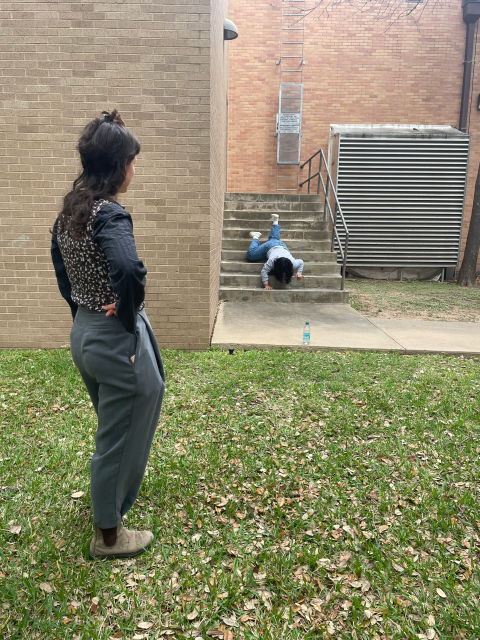
Hannah Spector is an interdisciplinary artist whose practice aims to transform spoken and written word into physical objects and media, including performance, video, sound, sculpture, printmaking, and drawing. Spector is an Assistant Professor in the Studio Department within UT’s College of Fine Arts. In this role, they teach CORE: Time & Technology, a unique class for first-year studio students that emphasizes technical skills and conceptual understanding of sound, video, and performance art.
Time-based work—art that unfolds over a specified duration—is integral to Spector’s artistic and pedagogical practices, which makes Landmarks Video a perfect tool for introducing students to the fundamentals of video art.
“Students are often coming in without having seen these forms of art before, and it can be jarring and confusing to them,” said Spector. “Showing them examples of this work out in the world slowly opens them up. The more present this ‘different’ work is in their daily surroundings, the more they see that there’s a rich tradition of time-based work all around them. It becomes a viable means of expression.”
Landmarks Video is experienced by hundreds of students who walk through the Fine Arts Building each day. Spector’s students have the opportunity to explore the works as part of their curriculum, learning about the techniques and conceptual frameworks employed by each video artist.
In March of 2024, Spector and the students viewed Cinthia Marcelle’s Confrontation (Unus Mundus Series), which depicts numerous fire jugglers performing in the crosswalk of a busy Brazilian intersection. “It sparked a great conversation,” Spector recalled, “Its vantage point, evoking a red-light camera or surveillance footage, became a point of entry to discussing camera perspective and how point-of-view shapes our subconscious understanding of an action. The piece is also a useful example of a performance captured on video rather than a video performance, a distinction that helps students see different ways performance can be enacted, documented, and circulated.”
Spector acknowledges challenges that come with teaching this unique art form but sees an opportunity to expand the horizons of young artists who haven’t yet explored the medium. “Often, video work can feel alienating, or like the entryway to understanding a piece is too confusing. But students become less intimidated through our group conversations, and it becomes a fun and active part of their academic landscape they can engage with.” For Spector, this form of exposure is a critical pathway to discovery and innovation.
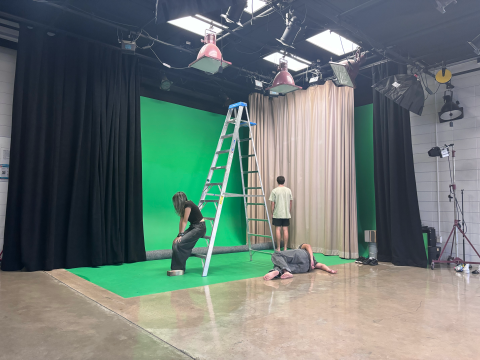
With Spector’s guidance, students are pushed to embrace new modes of creative thinking and cultivate awareness of the interaction between space, time, and action. Landmarks Video is not only an important tool for teaching and learning, but it also exemplifies boundary-pushing artistic expression. “The archiving and preservation of video work isn’t prioritized in the art world, and to have this as an approachable setting for students to engage with daily gives me great joy!” said Spector. “When something is deemed ‘collection’ or ‘museum-worthy’ it shows students that this work has weight, it has power and importance, and it is worth spending time with.”
Landmarks Video features the work of one artist each month in the ART Building, located at 23rd Street and San Jacinto Blvd. Videos are on view when the ART Building is open, typically from 7 am to 10 pm daily. Headsets to optimize sound may be checked out from the Visual Arts Center reception desk during operating hours. Many videos in the archive are also available at the Fine Arts Library.