


Autobiography: Circles, Howardena Pindell’s monumental new commission for the George I. Sánchez Building, stands as a legacy project for the artist. It unites three visual motifs that have anchored her practice for more than fifty years—circles, arrows, and numbers. Each motif has its own origin story, and together they illuminate Pindell’s lifelong commitment to abstraction as a vehicle for memory, identity, and social justice.
Circles
Pindell traces her use of circular dots to a childhood memory: red circles marking dinnerware designated for Black customers under Jim Crow segregation. By transforming this symbol of exclusion into a recurring language of beauty and resilience, she reclaims the form with intention and power.
Circles were also the first motif to guide her shift from figuration to abstraction. They appear as ellipses, perforations, spraypainted dots, and holepunched paper discs. Using an ordinary office hole punch, Pindell built richly textured surfaces that merge the order of the grid with shimmering, densely layered constellations. She often enhanced these works with glitter, perfume, powder, thread, and raised acrylic, creating compositions that are as sensorial as they are visual.
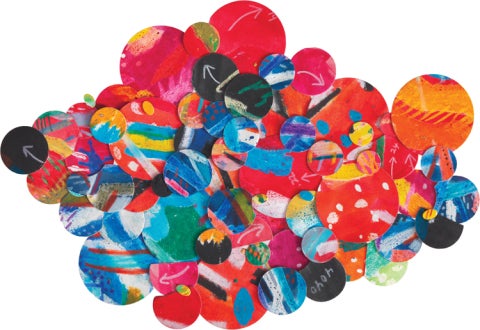
Howardena Pindell, Untitled #4D, 2009. Courtesy of the artist and Garth Greenan Gallery, New York.
Arrows
If circles evoke accumulation, arrows introduce movement. Pindell first used arrows and vectors prominently in her 1970s Video Drawings, where she drew on clear acetate laid over televised images. These works treat the screen—and mass media itself—as something to dissect, critique, and reframe.
In later pieces, arrows weave through fields of circles, numbers, and reference points inspired by charts and mapping systems. They can signal direction, contradiction, calculation, flight, or transformation, reflecting Pindell’s enduring fascination with science and systems of knowledge.
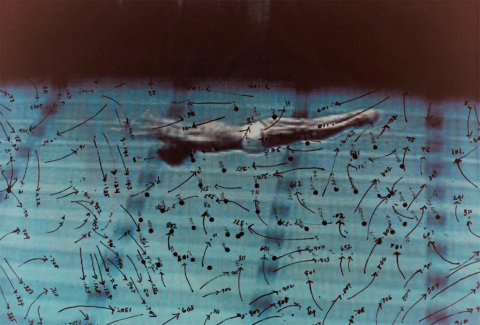
Howardena Pindell, Video Drawings: Swimming, 1975. Courtesy the artist and Garth Greenan Gallery, New York.
Numbers
Influenced by her mathematician father, Pindell developed an early appreciation for logic and order. Yet in her work, numbers resist fixed meaning. She often calls them “nonsense numbers”—arbitrary sequences that function as visual language rather than data.
Numbers carry both personal and historical resonance. They nod to her interest in mathematics while also invoking the tags used to identify enslaved Africans. Through this motif, Pindell subverts the rationality of numerical systems, transforming them into signs that hold memory, trauma, and lived experience.
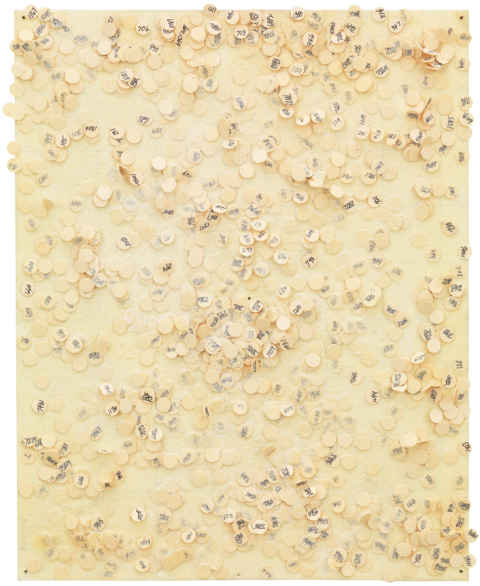
Howardena Pindell, Untitled #4, 1973. Courtesy the artist and Garth Greenan Gallery, New York.
A Language of Abstraction and History
Seen collectively, these motifs reveal how Pindell uses abstraction to generate depth, motion, and vibrant fields of color while grounding her work in personal and collective histories. They form a visual vocabulary that is both analytical and emotional, structured and intuitive.
Experience the work firsthand at the opening of Autobiography: Circles on April 23, and learn more during a free public lecture with curatorial contributor Valerie Cassel Oliver.