


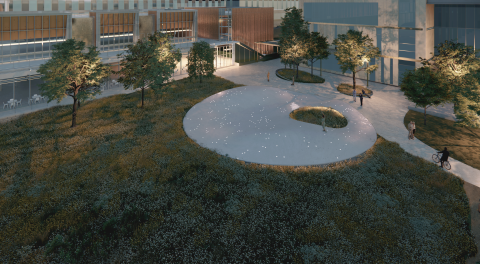
Landmarks announces a major new work by Maya Lin, one of the most influential artists of the last half‑century. Titled Floating Landscape, the 3,600 square-foot-structure extends Lin’s ongoing investigation of landscape, memory, and the built environment. It represents the artist’s first work of public art in Texas and first commission in the state. Landmarks will celebrate the opening of the project in April 2027, hosting a public conversation between Lin and Jana La Brasca, an art historian and curatorial contributor for the project. Additional details will be available in the coming months.
Lin is known for her groundbreaking, large-scale environmental artworks that establish unique connections to the land. Her installation for Landmarks will be sited on the grounds of the Autry C. Stephens Engineering Discovery Building, a new facility designed by CO Architects for the Cockrell School of Engineering. Conceived as a blend of sculpture, architecture, and ecological design, the work features a semi‑elevated, complex curved concrete structure with a central opening. At night, it will glow with embedded LED lights that correspond to the constellations in the Texas sky on September 15, 1883—the date of UT Austin’s founding. This celestial reference reflects Lin’s longstanding interest in connecting natural systems with civic identity and cultural memory. Accessible to all, the project will serve as a new public commons for the university, inviting students, faculty, and campus visitors to walk and gather on its undulating form. This new artwork was graciously supported by Cockrell School of Engineering alumnus Peyton Yates (B.S. and M.S. petroleum engineering 1965 and 1966). Yates has supported public art for decades and is proud to help bring this piece to the people of Texas.
Floating Landscape will be embedded within a restored meadow designed by Lin in collaboration with Lionheart Places and the Lady Bird Johnson Wildflower Center. The surrounding landscape will feature native grasses and herbaceous plants selected for long‑term ecological health and seasonal durability. The site also supports the ongoing ecological restoration of Waller Creek in Austin, demonstrating how public art, environmental stewardship, and historical commemoration can converge within a campus setting.