


In April, Landmarks unveiled Autobiography: Circles, a monumental new work by Howardena Pindell commissioned for the College of Education. The installation features a 20 x 50 foot design that is integrated into the glass façade of the George I. Sanchez building using ceramic frit, a digital print process in which ceramic ink is fused into glass. Behind the work’s luminous surface is a story of collaboration, technical experimentation, and a few unexpected challenges along the way.
Translating Pindell’s Language into Glass
For Nisa Barger, former Assistant Director of Collections at Landmarks, one of the earliest challenges was scale. Pindell is known for working with small, hand-punched circles, often used to create paintings or collages. Translating that intimate material language into a multi-story architectural installation required careful thought, testing, and team work.
Early in the collaboration between Pindell’s studio, Garth Greenan Gallery, and Landmarks, the project pointed towards a digital process. Source materials connected to Pindell’s studio practice were scanned, photographed, enlarged, and refined into a design that was suitable for architectural glass. Barger described this phase as one of the longest and most intricate parts of the project.
Material decisions were equally important. The team considered whether to replace the existing glass façade or create a secondary glass surface specifically for the art. Ultimately, it was decided that the composition could be integrated into a new glass façade, with the help of Viracon, a company that specializes in architectural glass and ceramic frit direct printing.
The ceramic frit process allowed the image to be printed onto the glass and fused with ceramic ink, creating a durable surface with strong color stability. Unlike lamination or decals, the material is less vulnerable to UV exposure and deterioration over time. That durability mattered for a work designed to live on the exterior of a busy campus building.
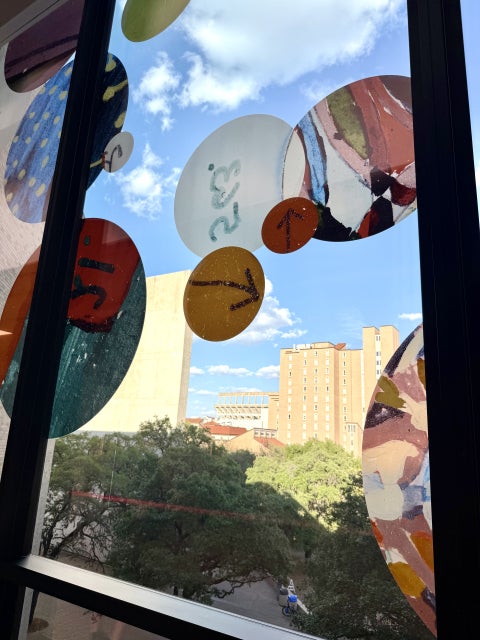
Color was another central concern. “We knew that getting the color right was going to be a big deal for this piece,” Barger said. The process required extensive testing to ensure that the final installation would preserve the vibrancy, detail, and transparency of Pindell’s composition. The result is a façade that can be experienced from both outside the building and within, where the circles remain visible across multiple floors.
A First Look for Landmarks Docents
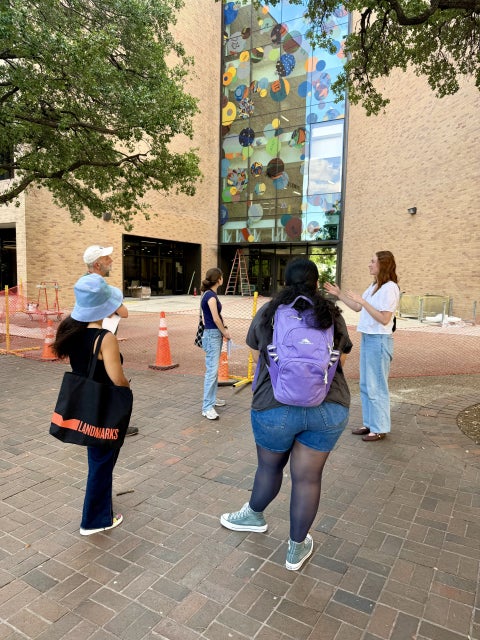
As the project neared completion, Landmarks’ docents were trained to guide visitors through the work. Through lectures, written materials, and an in-person tour led by Jo Roznovsky, Landmarks Education Coordinator, the docents learned about Pindell’s biography and the central themes of her work. They also explored the project’s connection to other works in the Landmarks collection, and developed questions designed to encourage close looking. Rather than offering a fixed script, the training supported a more conversational approach to touring.
“Going inside to look at it was not something that I had initially planned, but I really appreciated the docents’ curiosity,” Roznovsky said. Seeing the installation from inside gave the docents a fuller understanding of how the work changes with light, distance, and point of view. For Roznovsky, that kind of curiosity is central to Landmarks’ approach. Tours are not only about delivering information; they invite visitors to ask questions, make connections, and consider how public art can shape everyday experiences on campus.
A Last-Minute Repair
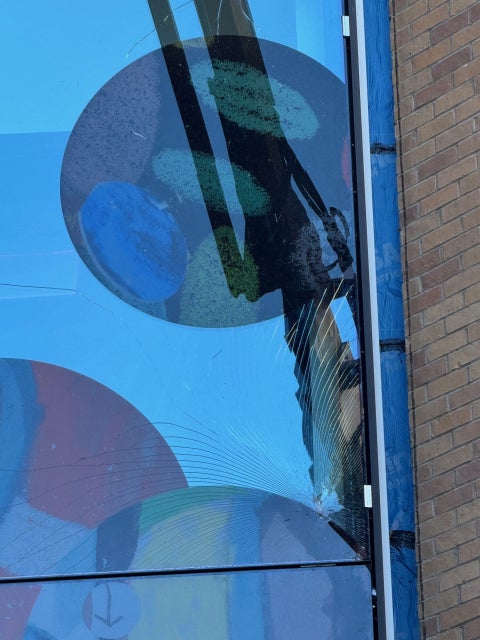
Like many ambitious construction projects, Autobiography: Circles also faced an unexpected setback. In late March, after the glass had been installed, a boom lift struck a nearby brick wall and ricocheted into one of the glass panes, causing it to break.
With the opening only weeks away, the project team moved quickly. Paula Rhodes, a project manager with UT’s Planning, Design, and Construction, focused on keeping all parties informed while preparing for multiple outcomes. A temporary vinyl replacement was considered in case the replacement glass did not arrive in time.
QA Construction ordered both a new glass pane and the vinyl backup, ensuring that the team had options. Because the color formula had already been perfected through previous testing, Viracon was able to move quickly. The company reprinted the pane, shipped it from Minnesota to Dallas for framing, and then sent it to Austin for installation. The team also replaced a pane that had an issue with color, reinforcing how important precision was to the final work.
“In general, things always come up in construction,” Rhodes said. “Every project is a little different. It’s about being flexible and just asking lots of questions.”
The replacement pane arrived earlier than expected, and was installed on April 9, in time for the opening celebration.
For visitors, the completed installation may appear seamless. But it required years of planning, material research, close collaboration, and quick problem-solving. Autobiography: Circles now stands as both a major new addition to the Landmarks collection and a testament to the many hands that helped bring Pindell’s vision into public view.